Straight Seam Welded Steel Pipe,Steel Profiles,Portable Container Houses,Cold-Rolled Seamless Steel Pipe,Hot-Rolled Seamless Steel Pipe,Spirally Welded Steel Pipe
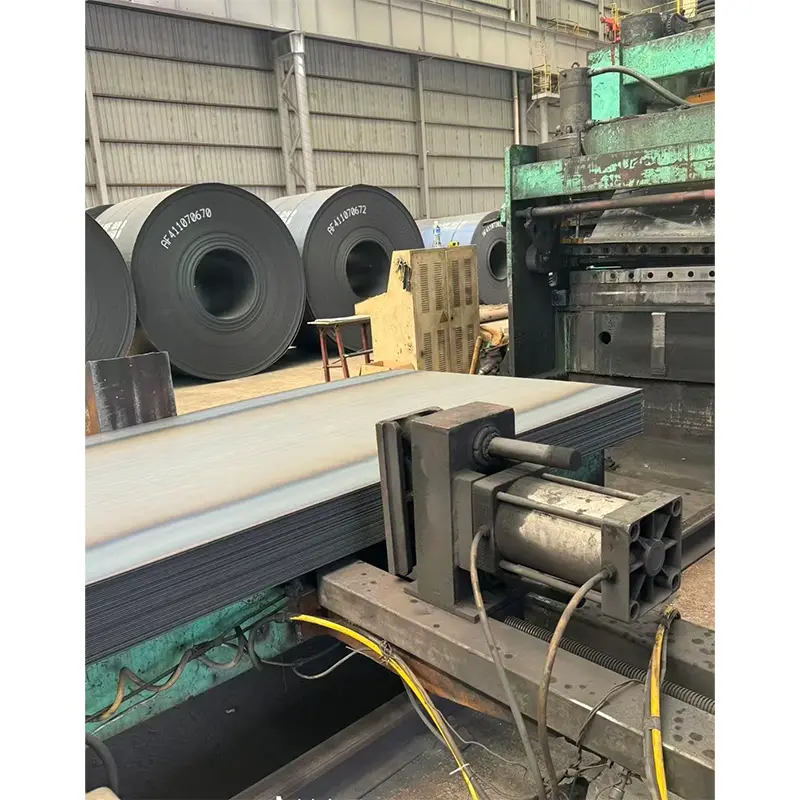
Every heavy fabrication project has a moment when raw material quality quietly decides the outcome. A plate that arrives with a slight crown, a few millimeters of width variation, or residual stress can slow your burning table, increase beveling time, and force your welders to fight fit-up gaps. The finished assembly still gets done, but the extra hours add up across dozens of plates. Hot Rolled Cut-to-Length Steel Plate changes that rhythm. It is not simply about getting steel; it is about receiving plates that are flattened, leveled, and sheared to the exact dimensions your production plan already assumes. When the plate matches the blueprint from the first layout mark, your team can move with confidence instead of compensation.
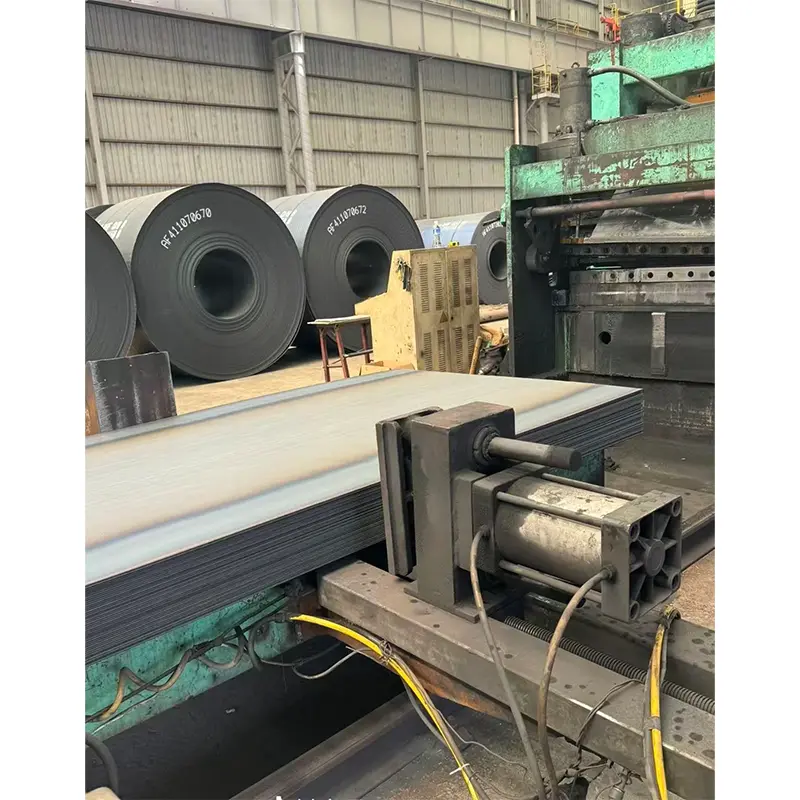
At Tianjin YuJie Steel Pipe Trading Co., Ltd., we have seen how much difference a properly processed plate makes. Our hot rolled cut-to-length steel plate is supplied to fabricators, machine builders, structural shops, and equipment manufacturers who need material that behaves predictably. The plates come from qualified mills, are leveled under controlled force, and are cut to length with consistent tolerances. The result is less warpage, better surface condition, and fewer interruptions on your shop floor. Whether you are building heavy weldments, crane girders, trailer frames, pressure vessel shells, or agricultural machinery, the quality of the plate becomes the quiet foundation of your finished product.
Hot rolled cut-to-length steel plate begins as a continuously cast slab that is reheated and rolled at high temperature. The hot rolling process reduces the slab to a desired thickness while the steel is above its recrystallization temperature. This gives the material its characteristic scale and mechanical properties. Rather than leaving the product in large coils, the steel is then uncoiled, leveled, and cut into flat sheets or plates of specified lengths. This cut-to-length operation is the step that transforms a heavy coil into stable, flat pieces that can be handled, stacked, and fed directly into fabrication.
The key distinction is that hot rolled cut-to-length steel plate is not re-rolled as a discrete plate. It comes from coil that is flattened and sheared. For many applications, this offers an excellent balance of cost, availability, and performance. The plate is widely used in structural steelwork, machine frames, flanges, base plates, stiffeners, gussets, and general fabrication where moderate surface finish and tight dimensional control are sufficient. Because the coil is processed in a dedicated cut-to-length line, the plate achieves a high degree of flatness compared to coil used directly, while keeping the economic advantages of hot rolled strip production.
Our customers often ask how this differs from quarto plate or discrete plate mill products. Quarto plate is rolled as individual plates and may offer some advantages in very thick sections beyond typical cut-to-length ranges. However, for thicknesses roughly up to 25 mm in many grades, hot rolled cut-to-length steel plate delivers excellent flatness, tight thickness tolerance, and a lower cost per ton. This makes it a practical choice for high-volume fabricators who need repeatable material without over-specifying.
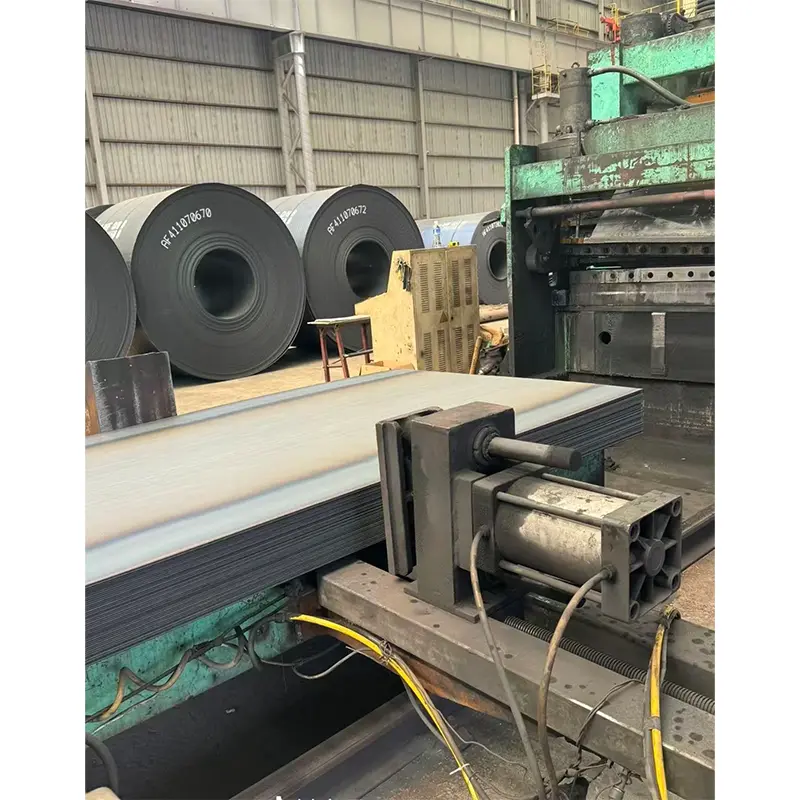
The term “cut-to-length” means the steel has passed through a leveling line that removes much of the coil memory. Incoming hot rolled coil typically has curvature, wavy edges, center buckle, or crossbow. A precision leveling machine with multiple rollers flexes the strip through alternating bends to redistribute internal stresses. After leveling, the strip enters a flying shear or stationary shear that cuts it to the exact length chosen by the customer. The plates are then stacked, inspected, and prepared for shipping. This process improves flatness far beyond what can be achieved by simply slitting coil and laying it flat.
For your shop, improved flatness means less time spent shimming, straightening, or rejecting plates for excessive distortion. It also means your CNC plasma or laser cutting table can maintain consistent torch height, which reduces dross and improves edge quality. Welders spend less time closing gaps, and assemblies come together with less force. These are not dramatic, visible changes; they are the small savings that compound across a production run.
Imagine a fabricating shop that wins a contract for 300 support brackets, each requiring a 10 mm thick plate measuring 500 mm by 1200 mm. If the plate arrives with even 3 mm of bow across its length, the operator must measure, mark, and sometimes flatten each piece before cutting. That is an extra two or three minutes per plate. Multiply by 300, and an entire day disappears into corrective handling. With properly leveled hot rolled cut-to-length steel plate, the pieces lie flat on the cutting bed, the program runs without interruption, and the finished parts stack with uniform dimensions. The same logic applies to base plates for columns, splice plates in bridges, mounting pads for equipment, and dozens of other common parts.
Another common pain point is inconsistent length. If plates arrive 3 mm long, the shop must trim each piece, creating scrap and extra handling. If they arrive short, they might be unusable. Cut-to-length processing from a reliable supplier like Tianjin YuJie Steel Pipe Trading Co., Ltd. brings length tolerances down to a few millimeters or less, depending on thickness and length. That reliability allows you to order exactly what your cutting program expects, reducing both waste and rework.
We supply hot rolled cut-to-length steel plate in a range of grades to match different structural and mechanical requirements. Common carbon structural grades include Q235B, Q355B, SS400, A36, and S235JR. For higher strength demands, we offer Q355C, S355JR, S355J2, A572 Grade 50, and similar equivalents. These grades cover most general fabrication, building construction, bridge components, machinery, and transport equipment uses. Each heat comes with mill test certificates that verify chemical composition and mechanical properties, so you can trace the material back to its origin.
Because the plate is produced from hot rolled coil, surface condition is typically black with a mill scale finish. For applications that require a cleaner surface for painting or welding, we can also arrange pickled and oiled material on request. Pickling removes the mill scale, leaving a grey metallic surface that is easier to clean and paint. Oiling then provides temporary corrosion protection during storage and transport. This option is especially useful for laser cutting operations where a cleaner surface can improve cut consistency.
Many buyers want to know the practical range before inquiring. The table below summarizes the standard dimensional capabilities for hot rolled cut-to-length steel plate supplied through Tianjin YuJie Steel Pipe Trading Co., Ltd. These are typical ranges and can be adjusted based on the specific grade and mill availability.
| Parameter | Common Range | Notes |
|---|---|---|
| Thickness | 1.5 mm – 25 mm | Other thicknesses available on request |
| Width | 600 mm – 2500 mm | Slit edges or mill edges |
| Length | 1000 mm – 12000 mm | Custom cut-to-length |
| Flatness tolerance | Generally within 3 mm per meter | Tighter tolerance on request |
| Length tolerance | ±2 mm to ±5 mm typical | Depends on thickness and length |
| Surface finish | Hot rolled black, pickled and oiled optional | Mill scale or descaled |
The exact values depend on the grade. The table below gives typical values for widely used carbon structural grades. Actual mill test certificates will accompany each shipment.
| Grade | Yield Strength (MPa) | Tensile Strength (MPa) | Elongation (%) | Typical Carbon Content |
|---|---|---|---|---|
| Q235B | ≥235 | 370 – 500 | ≥26 | ≤0.20% |
| Q355B | ≥355 | 470 – 630 | ≥22 | ≤0.24% |
| SS400 | ≥245 | 400 – 510 | ≥17 | ≤0.22% |
| A36 | ≥250 | 400 – 550 | ≥20 | ≤0.26% |
| S355JR | ≥355 | 470 – 630 | ≥22 | ≤0.24% |
These figures are indicative. For a specific heat, the mill test certificate provides the exact values, ensuring the material meets the required standard. If your project requires impact testing at low temperatures, we can arrange grades such as Q355D or S355J2 with charpy V-notch test results.
The practical uses of hot rolled cut-to-length steel plate are broad because the product combines flatness, thickness options, and economical pricing. One of the most common applications is structural steel fabrication. Column base plates, stiffener plates, gusset plates, end plates, and connection plates are routinely cut from this material. The uniform thickness and flatness ensure that bolt holes align, welds fit properly, and the assembled frame meets dimensional tolerances. Contractors appreciate that the plates can be ordered in exact lengths, reducing the need for field cutting and the associated safety risks.
In machinery manufacturing, flatness and dimensional accuracy directly affect the performance of the finished machine. Frames for presses, conveyor supports, laser cutting machine beds, and CNC equipment often require large flat surfaces. If the plate is not flat, the entire machine may vibrate, misalign, or fail to hold calibration. The cut-to-length process gives machinists a reliable starting point, reducing the need for stress relief or grinding before machining.
For heavy transport equipment, weight and strength must be balanced carefully. Trailer frames, truck chassis components, and rail car parts often use hot rolled cut-to-length steel plate in the 6 mm to 16 mm thickness range. The material can be formed, welded, and drilled without cracking, and its mechanical properties are well suited to dynamic loads. Because the plate arrives flat and cut to size, the production line can move faster, which matters for high-volume trailer builders.
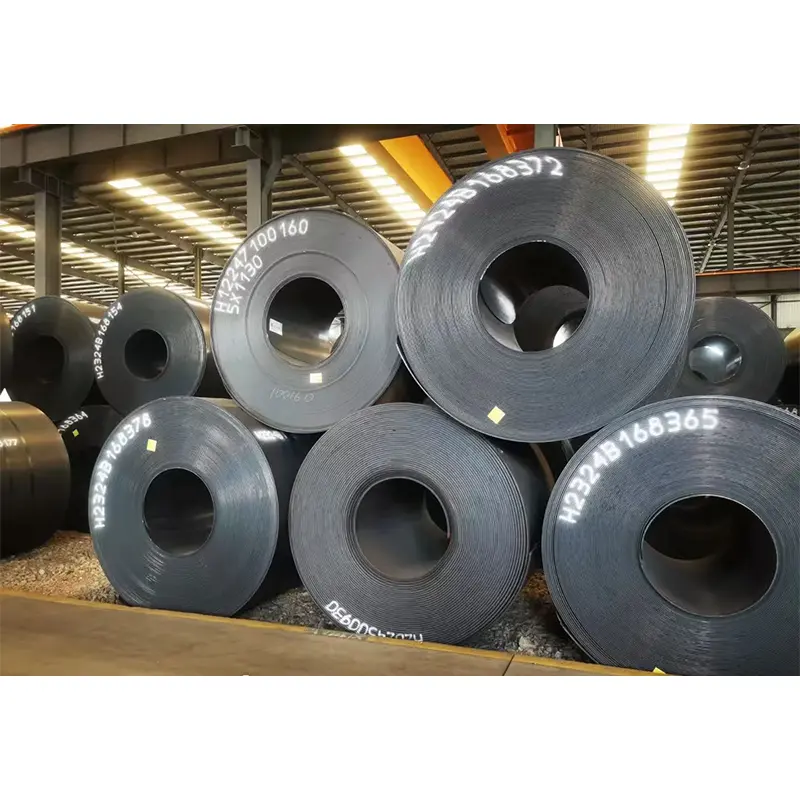
Pressure vessel and tank manufacturers also use hot rolled cut-to-length steel plate for shell courses and heads when the design allows. The material can be rolled into cylinders, welded, and tested. Flatness helps during rolling because a plate with waves or residual stress may form uneven curvature. Cut-to-length plates from coil are often used for smaller diameter tanks, air receivers, and storage silos where the thickness falls within the available range.
In agricultural machinery, plates are used for plow frames, harrow discs, planter frames, and loader buckets. The environment is harsh, with impact loads, abrasive soil, and weather exposure. A consistent plate with known mechanical properties helps manufacturers build durable equipment without over-engineering every component. The cost savings versus discrete plate can be significant over a full model year of production.
The energy sector consumes large quantities of steel plate for pipe supports, cable trays, access platforms, and equipment skids. These parts are often repetitive, allowing fabricators to batch cut hundreds of identical pieces. Hot rolled cut-to-length steel plate is ideal for such work because it can be supplied in exact lengths and widths, minimizing kerf waste. The plate's flatness also reduces the chance of parts binding on the cutting table or welding fixtures.
Infrastructure projects such as bridge bearing plates, expansion joint covers, sign structures, and guardrail components all benefit from cut-to-length processing. In these applications, dimensional tolerance and traceability are critical. Each heat of steel must be documented, and the plate must come with clear identification. Our team at Tianjin YuJie Steel Pipe Trading Co., Ltd. understands these requirements and provides proper marking, tagging, and mill certificates with every order.
One of the biggest differences between a commodity supplier and a true partner is how tolerances are handled. When you buy hot rolled cut-to-length steel plate from a general trader, you may not know which mill produced it, whether it was leveled on a modern line, or how long it sat in open storage. Those unknowns show up later as rust pits, wavy edges, or inconsistent thickness. At Tianjin YuJie Steel Pipe Trading Co., Ltd., we focus on the details that affect your production.
We work with selected mills and processing lines that maintain consistent thickness profiles across the coil width. We check incoming material for visible defects such as edge cracks, laminations, deep scale, and excessive camber. Before shipment, we verify that the plates are dry, properly stacked on wooden dunnage, and secured for transport. This reduces the chance of water staining, bending, or handling damage during transit. For export orders, we pay attention to container loading, using corner protectors and steel banding to keep the load stable.
Communication also matters. When you send an inquiry, we ask about the actual application, not just the grade and size. This helps us recommend the right surface condition, edge type, and flatness class. Sometimes a lower-cost black surface is perfectly fine. Other times, a pickled and oiled surface saves your painter hours of preparation. By understanding your end use, we can help you avoid overspending on unnecessary features or buying material that is under-specified for the job.
Every shipment of hot rolled cut-to-length steel plate is supported by mill test certificates. These certificates show the heat number, chemical composition, yield strength, tensile strength, elongation, and any impact results. We also retain samples and records, so if a question arises weeks later, we can trace the material quickly. This traceability is essential for projects that require third-party inspection or code compliance.
In addition to mill certificates, we perform visual inspection of the plates before dispatch. We look for surface defects such as rolled-in scale, pitting, scratches, and oil stains. We check for edge burrs or shear deformation that could affect fit-up. For plates with critical flatness requirements, we can arrange additional inspection or re-leveling. This does not mean every plate is perfect, but it does mean that obvious defects are caught before they reach your dock, saving you the frustration of receiving unusable material.
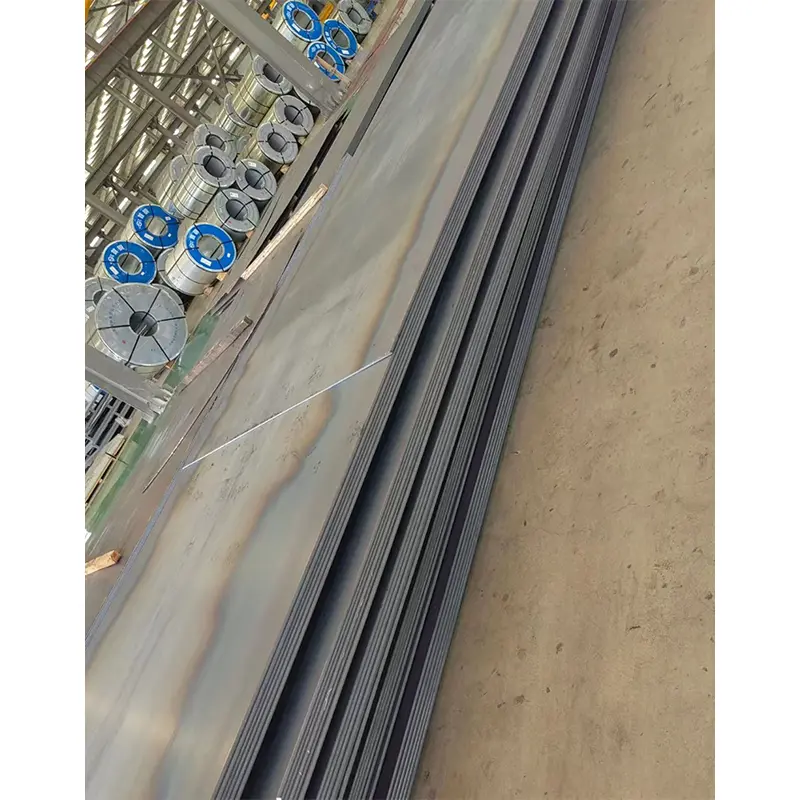
Most buyers do not get excited about steel plate until a bad shipment ruins their week. Late delivery, mixed lengths, wavy plates, or missing documents create stress that ripples through the entire project. The emotional payoff of working with a dependable supplier is calm confidence. When the truck arrives and the plates are exactly as ordered, your team can unload quickly, store the material without sorting, and start cutting.
This confidence extends to your customers. If you are a fabricator delivering a machine frame or structure, you want to know that the base material is consistent. That consistency shows in cleaner cuts, better weld quality, and fewer dimensional errors. Your own quality record improves, which helps you win more contracts or justify higher pricing. The raw material becomes a strategic advantage rather than a source of hidden costs.
For purchasing managers, the benefit is fewer phone calls chasing missing certificates, fewer disputes over rejected plates, and fewer production delays. For engineers, the benefit is a material that meets the specified mechanical properties without surprises. For business owners, the benefit is predictable cost per finished part. All of these converge on the same result: the project moves forward.
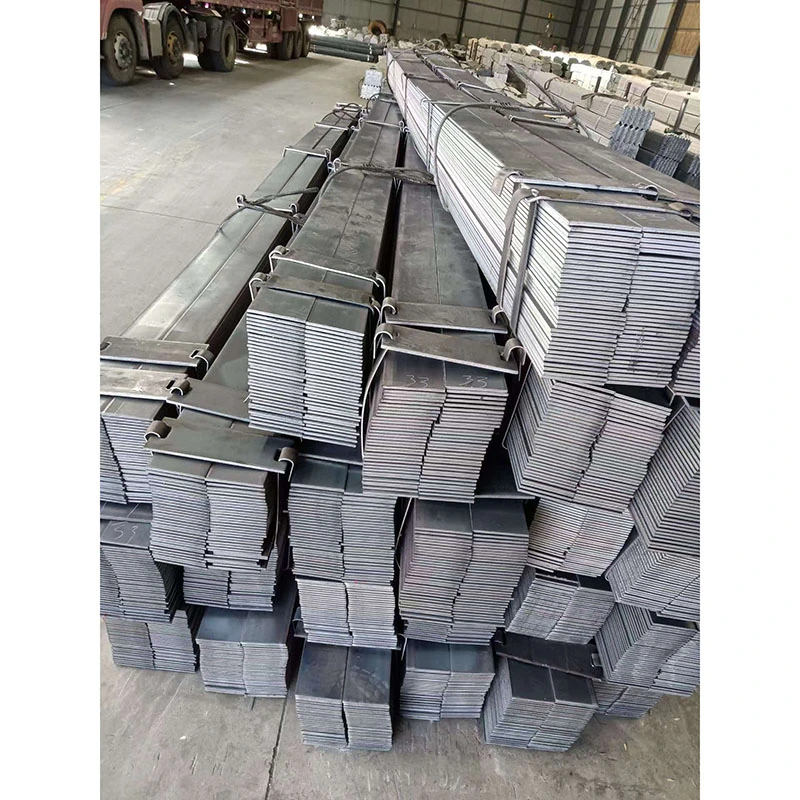
A company that builds compact construction equipment needs 50 metric tons of 12 mm thick hot rolled cut-to-length steel plate, grade Q355B, in sizes of 1500 mm by 6000 mm. They send drawings and a cutting plan. The material must arrive within three weeks to keep their production schedule. Our team confirms availability from the mill, arranges cut-to-length processing, and provides a proforma invoice. The plates are produced, leveled, and cut to length. Before loading, we take photos and send them to the buyer. The shipment is loaded into containers or onto a flat rack, with each bundle tagged by size and heat number.
When the plates arrive, the buyer checks a few dimensions against the packing list. Everything matches. The plates are flat enough to place directly on the CNC cutting bed. The operator starts the program without re-measuring every sheet. The cutting time per plate is reduced, the edge quality is consistent, and the forming and welding steps follow without rework. The buyer reorders three months later because the first batch performed exactly as expected. That is the kind of relationship hot rolled cut-to-length steel plate makes possible when it is supplied correctly.
Q: What is hot rolled cut-to-length steel plate used for?
A: It is used across many industries, including structural steel fabrication, machinery manufacturing, heavy transport, pressure vessels and tanks, agricultural equipment, energy infrastructure, and general metalworking. Typical parts include base plates, stiffeners, gussets, frames, brackets, flanges, and shell courses. Its flatness and dimensional consistency make it ideal for CNC cutting, welding, and forming operations where repeatability matters.
Q: What thicknesses are available for hot rolled cut-to-length steel plate?
A: We commonly supply thicknesses from 1.5 mm up to 25 mm. Within this range, cut-to-length processing is highly efficient and cost-effective. For thicknesses beyond 25 mm, we recommend checking with our sales team, because discrete plate may be more suitable depending on the grade and width. Custom thicknesses can often be arranged through specific mill rolling schedules.
Q: Can I order custom lengths and widths?
A: Yes. Cut-to-length processing is designed for custom lengths. Widths depend on the available mill coil width and the slitting capabilities. We can provide standard mill edge or slit edge depending on your tolerance and edge quality needs. When you send your cutting plan, we can often optimize plate sizes to reduce scrap and improve material utilization.
Q: How flat will the plates be?
A: Typical flatness for hot rolled cut-to-length steel plate is within about 3 mm per meter, but this can vary with plate thickness, width, and length. Thicker and smaller plates usually hold tighter flatness. If your application requires tighter flatness for laser cutting or machining, we can discuss re-leveling options or select material from mills with higher precision leveling lines.
Q: What surface finish is available?
A: The standard surface is hot rolled black with mill scale. Many fabricators use this finish for structural parts that will be primed or painted after blasting. For cleaner surfaces, we can supply pickled and oiled plates, which have the mill scale removed. Pickled and oiled material is especially helpful for laser cutting and for applications where surface cleanliness affects adhesion or appearance.
Q: What documents do you provide with the shipment?
A: Every shipment includes a packing list, commercial invoice, and mill test certificates. The mill test certificate shows the heat number, chemical composition, mechanical properties, and any impact test results if applicable. For export orders, we also provide documents for customs clearance and may arrange third-party inspection if required by the contract.
Q: What is the minimum order quantity?
A: Minimum order quantities depend on the specific grade, thickness, and destination. For many standard sizes, one full container load is the most economical. However, smaller trial orders can sometimes be arranged for customers evaluating the material. We encourage you to send your first inquiry with the sizes and quantities you need, and we will provide a realistic quotation and lead time.
Q: How does pricing compare with discrete plate?
A: In the common thickness range up to about 25 mm, hot rolled cut-to-length steel plate is often more economical than discrete plate because coil production and continuous leveling are highly efficient. The cost per ton is generally lower, and the ability to order exact lengths reduces waste. For thicker plates or special widths, discrete plate may be competitive, so we help you choose the best option based on your total cost of ownership.
Q: Can this plate be used for galvanizing or painting?
A: Yes. Hot rolled cut-to-length steel plate can be galvanized, painted, or powder coated. For galvanizing, the surface must be clean and free of heavy mill scale or oil. We can supply pickled material if you want a cleaner starting surface. For painting, many customers blast the plates first to achieve the required profile. We can also arrange pre-primed plate on request for certain projects.
Q: How is the material packaged for export?
A: Plates are stacked in bundles of similar size and weight. Each bundle is placed on wooden dunnage and secured with steel straps. For container loading, we use edge protectors and blocking to prevent shifting. For open-top or flat-rack shipments, we apply additional weather protection such as VCI paper or plastic film. The packaging is designed to keep the plates flat, dry, and traceable during transit.
There is a certain satisfaction in watching a well-prepared plate move through your shop without drama. The torch arcs cleanly, the parts fall off the skeleton with minimal grinding, and the weld joints fit tightly without hammering. That satisfaction is not accidental. It comes from choosing hot rolled cut-to-length steel plate that has been leveled, squared, and inspected before it ever reaches your floor. It comes from working with a supplier like Tianjin YuJie Steel Pipe Trading Co., Ltd., who treats your cutting schedule as seriously as you do.
When you send an inquiry, include your sizes, grade, surface preference, and destination. We will respond with a clear quotation, available lead time, and a realistic assessment of what will work best for your project. The more we know about your application, the better we can serve you. Whether you need a single trial bundle or a multi-container shipment, the standard of care remains the same.
Your next project does not have to accept wavy plates, mixed lengths, or missing paperwork. You can choose a material source that understands the value of flat, predictable, cut-to-size steel. The plates arrive, you cut, you weld, you ship. The rest of the process becomes a little quieter, a little faster, and a lot more reliable.